
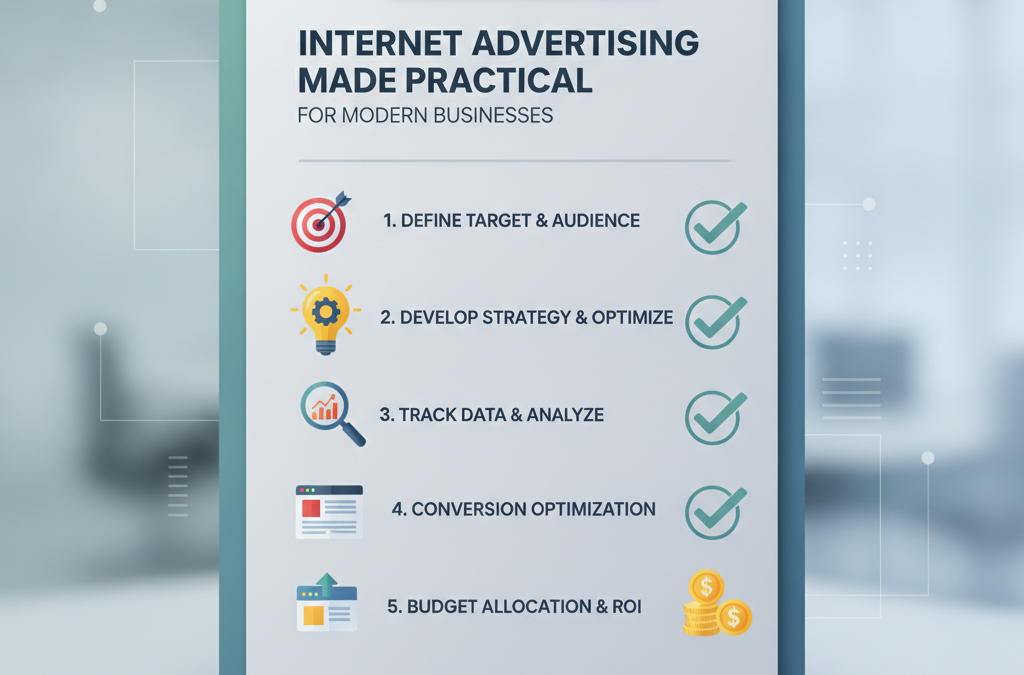
Why internet advertising matters for photography businesses
Internet advertising is the paid promotion of a business through digital channels such as search engines, websites, social platforms, video platforms, shopping feeds, and apps. For photographers, that can mean appearing when someone searches for a wedding photographer, promoting studio portrait sessions, retargeting visitors who viewed a pricing page, or showcasing commercial photography services to local businesses.
A broader business-focused guide to internet advertising made practical for modern businesses explains the core idea well: paid digital visibility works best when targeting, tracking, landing pages, and follow-up are connected. For a photography brand, that connection is especially important because clients often choose based on trust, style, availability, location, and portfolio quality—not clicks alone.
Paid ads can support a photography business alongside organic search, referrals, social media, and SEO Services. SEO helps a photography website earn long-term visibility, while paid campaigns can create faster exposure for specific services, seasonal offers, portfolio launches, or local search demand.
How internet advertising works for photographers
At its core, internet advertising connects an audience, a message, a creative asset, and a conversion goal. A photographer chooses who they want to reach, where the ad should appear, what the ad should say or show, and what action should count as success. That action might be an enquiry form, a phone call, a booking request, a pricing guide download, or a consultation.
For example, a wedding photographer may run search ads for people actively looking for photographers in a specific city. A portrait studio may use social media ads to introduce seasonal family sessions. A commercial photographer may use remarketing to stay visible to marketing managers who visited a service page but did not enquire. In each case, the campaign needs to align search intent, visual style, landing page content, and enquiry process.
This is where Google Ads Management becomes more than simply launching ads. For photography businesses, strong campaign management may include refining keywords, excluding irrelevant searches, testing ad copy, reviewing search terms, improving landing pages, and tracking which enquiries are actually worth pursuing.
Which internet advertising channels fit different photography goals?
Not every advertising format serves the same purpose. Some channels capture people who are already looking for a photographer, while others help build awareness before someone is ready to book. The right choice depends on the photography service, sales cycle, location, budget, and portfolio strength.
Search advertising for high-intent enquiries
Search ads place a photography business in front of people who are actively searching for a service.
- How it works: Ads appear for keyword-based searches, and relevance between the search term, ad copy, and landing page affects campaign efficiency.
- Best fit: Wedding photography, newborn photography, headshots, event photography, real estate photography, and other services with clear search demand.
- Example: A photographer may target searches such as “corporate headshots near me,” “wedding photographer toronto,” or “real estate photographer.”
Social media advertising for visual discovery
Social media ads are useful for photographers because the work itself is visual. These campaigns can introduce a style, offer, or portfolio to people who may not be searching yet.
- How it works: Platforms deliver image, carousel, story, reel, or video ads based on audience signals, creative engagement, and campaign objectives.
- Best fit: Portrait sessions, maternity photography, engagement shoots, mini sessions, branding photography, and lifestyle campaigns.
- Example: A studio promoting holiday family sessions may use paid social to show sample images and send viewers to a booking page.
Remarketing for people who already viewed your work
Remarketing reconnects with people who previously visited a photography website, viewed a portfolio, or interacted with the brand.
- How it works: Audience lists are built from site visits or platform engagement, then used to show follow-up ads.
- Best fit: Wedding photography, commercial photography, branding photography, and any service where the decision takes time.
- Example: Someone who viewed a pricing or portfolio page can later see an ad reminding them to book a consultation.
Display and video advertising for brand awareness
Display and video ads can support broader visibility, especially when the photographer needs to show personality, process, or visual quality.
- How it works: Ads appear across websites, apps, or video placements using audience, contextual, or remarketing signals.
- Best fit: Brand-building campaigns, commercial photography, destination weddings, workshop promotion, and visual storytelling.
- Example: A commercial photographer may use a short video to show behind-the-scenes production quality before sending prospects to a portfolio page.
What photographers should check before spending more on ads
More ad budget does not automatically mean more bookings. Photography campaigns often underperform when the audience is too broad, the landing page is generic, the portfolio does not match the ad promise, or enquiries are not tracked clearly. Before increasing spend, review the following areas.
1. Define the conversion you want
A photography ad campaign should be built around a clear action. That may be a contact form submission, phone call, consultation booking, pricing guide request, or direct purchase of a session package.
Main check: Make sure the conversion is trackable and connected to a real business outcome.
Common issue: Counting every website visit as success can hide whether the campaign is producing real enquiries.
2. Match the campaign to the client’s buying stage
Someone searching for a wedding photographer may be much closer to booking than someone casually scrolling through social media. Search ads often capture existing demand, while social and display ads may introduce your work earlier in the decision process.
Main check: Ask whether the audience is actively looking now or needs more education and inspiration first.
Common issue: Expecting immediate bookings from awareness campaigns without remarketing or follow-up.
3. Use targeting and exclusions carefully
Photography services are often location-specific, style-specific, or budget-specific. Targeting should reflect where the photographer works, which services they offer, and which enquiries are worth paying for.
Main check: Review locations, search terms, audience segments, and negative keywords regularly.
Common issue: Paying for broad traffic from people outside the service area or searching for unrelated photography topics.
4. Send ad traffic to the right landing page
If an ad promotes wedding photography, the click should not land on a generic homepage with every service mixed together. The landing page should show relevant images, explain the service clearly, provide trust cues, and make the next step easy.
Main check: Compare the exact ad message with the first screen of the landing page.
Common issue: Sending all paid traffic to the homepage instead of a service-specific page.
5. Review enquiry quality, not just click volume
A photography campaign can generate clicks and still fail if the enquiries are not aligned with your pricing, location, availability, or style. Reviewing lead quality helps determine whether the campaign is attracting the right people.
Main check: Compare ad platform data with actual enquiries, calls, and booked clients.
Common issue: Optimizing for cheap clicks instead of qualified photography enquiries.
What makes photography ads different from ads in other industries?
Photography is a trust-based and style-driven service. A client is not only buying a final image; they are choosing a person or studio to capture an important moment, represent a brand, or produce visual assets with care. That means the creative side of the ad matters as much as the targeting.
- Portfolio relevance matters: Ads should show the type of work being promoted, whether that is weddings, portraits, product photography, or corporate headshots.
- Style attracts and filters clients: Bright editorial images, documentary wedding work, polished studio portraits, and natural-light family sessions attract different audiences.
- Trust signals reduce hesitation: Clear service details, strong image galleries, testimonials, process explanations, and easy contact options can support conversion.
- Availability can influence urgency: Seasonal campaigns, wedding dates, holiday sessions, and event coverage may require tighter timing.
- Mobile experience is essential: Many prospects will view a photographer’s ad and portfolio from a phone before enquiring.
How SEO and PPC work together for photographers
SEO and PPC are often compared as if one must replace the other, but photography businesses usually benefit from using them together. SEO helps build long-term visibility for services, locations, blog posts, portfolio categories, and informational searches. PPC can create faster visibility for priority services or competitive terms.
For example, a photographer may use paid search to test which services generate enquiries quickly, then use SEO to build stronger organic pages around those services over time. Paid campaigns can reveal which search terms attract serious clients, while SEO can reduce dependency on paid clicks once organic visibility improves.
A blended approach may also require better website structure, stronger service pages, and improved conversion paths. In that situation, Website Design & Development can become part of the advertising conversation because even well-targeted ads struggle when the website does not communicate clearly or load smoothly.
A practical comparison
- SEO: Useful for long-term visibility, local service pages, portfolio indexing, educational content, and ongoing discovery.
- PPC: Useful for immediate visibility, seasonal campaigns, launch periods, booking gaps, and competitive search terms.
- Combined strategy: Useful when a photography business wants both near-term enquiries and stronger long-term search presence.
What shapes ROI in photography advertising campaigns?
Return on investment in internet advertising is shaped by more than the ad platform. For photographers, ROI depends on the quality of the audience, the strength of the images, the clarity of the offer, the landing page experience, the enquiry process, and how well the photographer follows up.
A campaign may look busy because it receives clicks, but that does not guarantee meaningful bookings. If the page is slow, the pricing expectations are unclear, or the portfolio does not match the ad, potential clients may leave without enquiring. Likewise, if enquiries are not tracked properly, it becomes difficult to know which campaigns are worth continuing.
Common ROI drivers
- Search intent: Queries close to booking intent usually behave differently from broad research searches.
- Creative quality: Photography ads depend heavily on strong visuals that match the promoted service.
- Landing page clarity: The page should explain the service, show relevant work, and make the next step obvious.
- Lead quality: Fewer qualified enquiries may be more valuable than many poor-fit contacts.
- Tracking accuracy: Without reliable conversion tracking, budget decisions can drift away from real business outcomes.
- Follow-up speed: Photography enquiries often cool down if replies are delayed or incomplete.
How local photographers can compete with internet advertising
Local photography advertising is not only about spending more. It is often about being more relevant to the right audience in the right service area. A smaller studio can compete effectively when its ads, location targeting, portfolio, and landing pages are tightly aligned.
For local photographers, campaign structure should reflect real buying behaviour. A family photographer may need ads around seasonal sessions and nearby suburbs. A headshot photographer may focus on professionals, teams, and business districts. A real estate photographer may prioritize local agents, property managers, and brokerages.
Ways local photography advertisers improve competitiveness
- Define realistic service areas: Avoid paying for clicks from locations that are too far away or unprofitable to serve.
- Create service-specific pages: Send users to pages for weddings, headshots, products, events, or portraits instead of one general page.
- Show local relevance: Use location cues, service details, and portfolio examples that match the audience.
- Track calls and forms separately: Different enquiry types may have different value and booking quality.
- Support ads with organic visibility: Local SEO, business profile accuracy, and strong website content can reinforce paid campaigns.
Choosing digital marketing help for a photography business
Some photographers manage ads themselves, while others work with a marketing partner. If outside support is needed, the right provider should understand more than campaign setup. They should be able to explain how paid traffic connects to bookings, website performance, analytics, SEO, and conversion quality.
When comparing Digital Marketing Services, photographers should ask practical questions. Who owns the ad account? How are conversions tracked? How often are search terms reviewed? Will landing pages be improved? How is enquiry quality measured? Clear answers matter because paid media exposes weaknesses quickly.
What to screen for
- Transparent account ownership: The photography business should retain access to ad platforms and analytics.
- Conversion tracking: Calls, forms, bookings, and other meaningful actions should be measured properly.
- Landing-page accountability: A marketing partner should care about the page experience, not just the click.
- Creative awareness: Photography ads require strong visual selection and service-specific messaging.
- Cross-channel judgment: Ads, SEO, local search, content, and website improvements should work together.
Quick facts about internet advertising for photographers
- Paid ads can create visibility quickly, but they still need refinement. Search terms, audiences, exclusions, and landing pages should be reviewed regularly.
- Clicks are not the same as clients. A campaign should be judged by enquiry quality, bookings, and business fit.
- Strong visuals help, but they are not enough alone. The offer, page structure, call to action, and follow-up process also matter.
- SEO and PPC can support each other. Paid campaigns can test demand while SEO builds longer-term visibility.
- Tracking is essential. Without reliable conversion data, it is difficult to know which ads are helping the business.
FAQs About Internet Advertising for Photographers
Can internet advertising help photographers get more bookings?
Yes, internet advertising can help photographers reach people searching for services or discovering visual work online. Results depend on targeting, creative quality, landing pages, conversion tracking, and how well enquiries are handled after they arrive.
Is Google Ads or social media advertising better for photographers?
It depends on the goal. Google Ads can be effective for high-intent searches such as wedding photography, headshots, or real estate photography. Social media advertising can be useful for visual discovery, seasonal sessions, brand awareness, and retargeting.
What causes photographers to waste money on ads?
Common causes include broad targeting, weak negative keywords, generic landing pages, unclear calls to action, poor conversion tracking, and ads that do not match the photographer’s actual services or style.
Should photographers advertise to their homepage?
Usually, a service-specific landing page is stronger. Someone clicking an ad for wedding photography should see wedding images, wedding service details, trust signals, and a clear enquiry path rather than a general homepage with every service mixed together.
Should a photography business start with SEO or paid ads?
If immediate visibility is needed, paid ads can help generate traffic sooner. If the goal is long-term discovery and reduced reliance on paid clicks, SEO is important. Many photography businesses benefit from using both together.
Final thoughts
Internet advertising can be a practical growth channel for photographers when it is treated as more than buying clicks. The strongest campaigns connect audience intent, visual quality, service-specific messaging, landing-page clarity, and reliable tracking. If a photography business is reviewing paid ads, SEO, website performance, or conversion tracking, it may help to ask informed questions before increasing spend. For tailored support, 📩 Ask an SEO/PPC question.
Recent Comments