
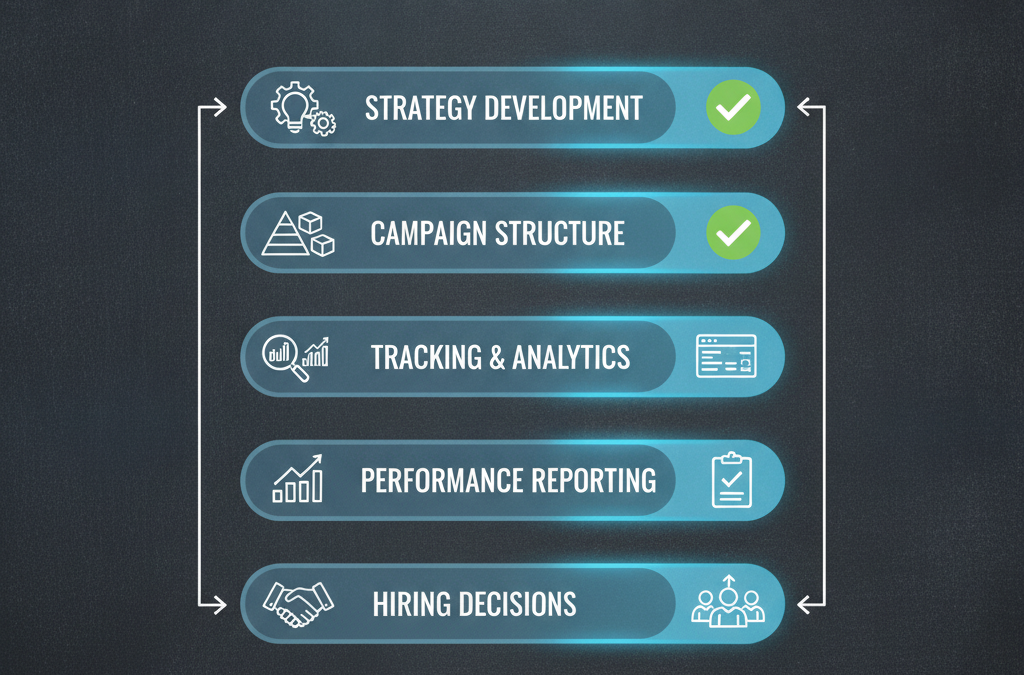
A PPC specialist helps photography businesses plan, manage, and improve paid search campaigns so advertising spend is connected to real booking intent, conversion tracking, landing pages, and measurable inquiries. For photographers, this means going beyond clicks and focusing on actions such as quote requests, consultation bookings, wedding inquiries, commercial project leads, studio calls, and online package purchases.
Paid search can be especially useful in photography because many clients search with urgent or high-intent phrases such as “wedding photographer near me,” “corporate headshots,” “product photography studio,” or “family photographer pricing.” For a broader explanation of the role, this PPC specialist guidance outlines how paid search management connects keywords, ads, budgets, tracking, and reporting.
For a photography studio, the key question is not simply whether ads are generating traffic. The more important question is whether those clicks are becoming qualified leads from people who match your services, location, style, availability, and price range.
Quick Facts: PPC Specialist for Photographers
The practical version for photography businesses.
- What: A PPC specialist manages paid search campaigns across keywords, ads, bids, budgets, landing pages, tracking, and reporting.
- Who: The role is useful for wedding photographers, portrait studios, commercial photographers, product photographers, event photographers, and photography businesses that rely on inquiries or bookings.
- Where: PPC work usually happens inside platforms such as Google Ads, Google Analytics 4, Google Tag Manager, Merchant Center, and reporting dashboards.
- How: Campaigns improve through search query reviews, negative keywords, ad copy testing, bid adjustments, conversion tracking, and landing page recommendations.
- Why: Strong PPC management helps reduce wasted spend, improve lead quality, and make advertising performance easier to evaluate.
Why PPC Matters in Photography Marketing
Photography is a visual business, but search behaviour still plays a major role in how clients choose a provider. A person may discover a photographer on social media, but when they are ready to compare availability, pricing, packages, or location, they often turn to search engines.
This is where a PPC specialist can help. Paid search campaigns can put a photography business in front of people who are actively looking for a specific service. The challenge is that not every search is equally valuable. Someone searching for “how to photograph a wedding” has different intent than someone searching for “wedding photographer available in October.”
A PPC specialist separates these different levels of intent and structures campaigns so the budget is more likely to reach people who are close to taking action. That work includes keyword research, campaign segmentation, ad writing, landing page alignment, and conversion tracking.
For photography businesses comparing paid search with other marketing channels, Zigma Internet Marketing connects PPC with broader Digital Marketing Services so website structure, SEO, analytics, and campaign data work together.
What a PPC Specialist Actually Does for a Photography Studio
A PPC specialist manages pay-per-click advertising, most often through Google Ads or Microsoft Ads. Pay-per-click means an advertiser pays when someone clicks an ad, but the real value depends on what happens after that click.
For a photographer, the specialist may build campaigns around different services such as weddings, headshots, newborn sessions, family portraits, real estate photography, product photography, or commercial shoots. Each service can attract a different type of client, so each campaign may need different keywords, ad copy, budgets, and landing pages.
The specialist also needs to define what counts as a meaningful conversion. For a photography website, this may include a contact form submission, phone call, package inquiry, consultation booking, or request for availability. If tracking is incomplete, the campaign may appear active without showing whether it is producing useful leads.
A common mistake is sending all paid traffic to the homepage. A person searching for “corporate headshot photographer” should usually land on a page that directly explains headshot services, pricing context, portfolio examples, turnaround expectations, and a clear inquiry path.
Turning Photography Search Clicks Into Useful Data
Paid search works by matching ads to user searches, but the match is not always perfect. A broad term like “photographer” may include people looking for jobs, tutorials, camera advice, free images, editing tips, or professional services. A PPC specialist reviews real search terms and filters out poor-fit traffic.
Search query analysis is especially important for photographers because many phrases sound relevant at first but do not represent paying clients. Searches that include “course,” “jobs,” “free,” “DIY,” “ideas,” “poses,” or “camera settings” may not be appropriate for a lead generation campaign.
Negative keywords help prevent repeated waste. For example, a portrait studio may need to exclude searches related to photography classes, stock images, equipment, editing presets, or employment if those clicks do not support the studio’s business goals.
When Zigma Internet Marketing manages Google Ads Management, campaign data can be reviewed alongside tracking, landing pages, and customer acquisition goals rather than treated as isolated ad account activity.
Ad Copy for Photographers Should Pre-Qualify the Client
Good photography ad copy does more than sound attractive. It helps the right client understand whether the service fits their need. This can include details about location, photography style, booking type, studio availability, commercial use, session format, or consultation process.
For example, a wedding photographer may want ad copy that mentions documentary-style coverage, destination availability, full-day packages, or engagement sessions. A corporate photographer may need copy that references team headshots, office sessions, brand imagery, or fast scheduling.
This clarity matters because every unnecessary click costs money. If an ad is too broad, it may attract people who are not looking for the kind of photography being offered. A PPC specialist tests ad messaging to find a balance between visibility and lead quality.
Landing Pages Matter as Much as Ads
Photography is portfolio-driven, so the landing page experience can strongly affect campaign performance. A paid search visitor should quickly see relevant images, service details, location information, trust signals, and a clear next step.
A PPC specialist may identify landing page issues such as slow load time, unclear calls to action, weak mobile layout, too many distractions, missing service information, or a portfolio that does not match the ad. These issues can reduce inquiries even when the campaign is attracting the right audience.
For photographers, a strong landing page usually answers practical questions: What type of photography do you provide? Where do you work? What does the process look like? How can a client check availability or request a quote? The easier those answers are to find, the easier it is to evaluate PPC performance.
If the website needs stronger service pages or better conversion paths, Zigma Internet Marketing also supports Website Design & Development for businesses that need landing pages aligned with paid traffic.
PPC Specialist vs Platform Automation
Advertising platforms now include automated bidding, broad matching, audience signals, and asset generation. Automation can be useful, but photography businesses still need human judgment because not every conversion has the same business value.
For example, one campaign may generate many low-value inquiries from people asking for free shoots, student projects, or services outside the photographer’s location. Another campaign may generate fewer leads but from clients who are a better fit. A PPC specialist helps interpret that difference.
Manual control, automation, and hybrid PPC management
A) Manual control: A PPC specialist directly manages keywords, match types, bids, ad copy, and budget allocation.
- How it works: The specialist makes specific changes based on search terms, conversion data, device performance, and campaign goals.
- Best fit: Manual control can be useful for niche photography services, limited budgets, or campaigns where lead quality must be tightly filtered.
- Example: A product photographer may exclude searches for stock photos, free product images, editing tutorials, and photography jobs.
B) Platform automation: Automated bidding and campaign types use platform signals to adjust delivery at scale.
- How it works: The platform uses conversion data, audience patterns, device signals, and auction conditions to adjust ad delivery.
- Best fit: Automation works better when conversion tracking is accurate and the account has enough clean data.
- Example: A studio with reliable form tracking may use automated bidding once high-value inquiries are separated from softer engagement actions.
C) Hybrid management: A PPC specialist sets the structure, tracking, exclusions, creative direction, and testing priorities while using automation where it supports the campaign goal.
- How it works: The specialist gives the platform better inputs, then reviews whether automated decisions are producing useful business outcomes.
- Best fit: Hybrid management fits many photography accounts because it combines machine learning with business judgment.
- Example: A wedding photography campaign may use automated bidding only after consultation requests and low-value contact form submissions are tracked separately.
Skills That Separate Strong PPC Management From Basic Setup
Basic setup can get ads running. Strong PPC management makes a photography campaign easier to diagnose, improve, and connect to actual bookings. The difference often appears in details that are not visible when looking only at clicks and impressions.
A capable PPC specialist understands how search intent changes across photography keywords. Searches with “near me,” “pricing,” “available,” “studio,” “portfolio,” “wedding,” “commercial,” or “same day” can signal very different needs.
Technical fluency also matters. Google Analytics 4, Google Tag Manager, call tracking, form tracking, conversion imports, and CRM data can all affect decision-making. If the tracking is wrong, the campaign may optimize toward the wrong actions.
Core Capabilities to Look For
- Search intent mapping: Keywords are grouped by the type of client decision, not only by similar wording.
- Negative keyword discipline: Irrelevant searches are reviewed regularly so wasted clicks do not keep repeating.
- Conversion tracking accuracy: Calls, forms, quote requests, and bookings are measured in a way that reflects business value.
- Landing page feedback: The specialist can identify when the page, not the ad, is limiting inquiries.
- Readable reporting: Reports explain what changed, what was tested, and which metrics affected decisions.
How to Evaluate a PPC Specialist Before Hiring One
Hiring a PPC specialist for a photography business should involve more than asking whether they know Google Ads. A better test is whether they ask about your services, client types, booking process, lead quality, location, website experience, and conversion tracking before recommending a campaign structure.
Step 1: Ask How Photography Conversions Will Be Defined
A specialist should clarify which actions count as meaningful conversions. A phone call, general contact form, wedding availability request, commercial quote request, and newsletter signup do not carry the same value.
What to listen for: Clear separation between high-value inquiries and soft engagement signals.
Risk if skipped: Campaigns may optimize for easy actions that do not produce real bookings.
Step 2: Review How Search Terms Are Handled
Search term reviews show whether the account is attracting the right audience. A PPC specialist should explain how often searches are reviewed and how negative keywords are added.
What to listen for: Specific references to query patterns, irrelevant intent, and budget leakage.
Risk if skipped: The same poor-fit searches can keep spending budget month after month.
Step 3: Check Whether Landing Pages Are Included
PPC performance is strongly tied to the page after the click. A specialist who ignores landing pages may miss problems with image loading, message match, form friction, or unclear calls to action.
What to listen for: Practical comments about page intent, portfolio relevance, mobile layout, trust signals, and inquiry paths.
Risk if skipped: Ads may drive qualified visitors to a page that fails to convert them.
Step 4: Ask How Reporting Connects to Decisions
A useful report should not only list impressions, clicks, and cost per click. It should explain what changed, what was learned, and which action will be taken next.
What to listen for: Plain explanations of tests, trade-offs, and account changes.
Risk if skipped: Reporting can become a monthly data dump with little connection to improvement.
Step 5: Confirm Account and Data Ownership
Access and ownership should be discussed before campaigns begin. The photography business should understand who owns the ad account, analytics setup, tags, landing pages, and historical performance data.
What to listen for: Transparent access practices and clear documentation.
Risk if skipped: A studio may lose visibility into performance history if a vendor relationship ends.
SEO and PPC Work Better When Photography Data Is Shared
SEO and PPC solve different timing problems. PPC can test messaging, search demand, and landing page performance quickly once campaigns are approved. SEO usually builds visibility over a longer period through content quality, technical health, authority, and search relevance.
For photographers, PPC search terms can reveal which services people are actively searching for and which phrases are more likely to generate inquiries. SEO content can then support long-term visibility for useful topics such as session planning, service comparisons, portfolio categories, and location-specific photography pages.
A high-converting paid keyword may deserve a dedicated landing page and an organic content plan. A low-converting keyword with heavy research intent may be better suited for an educational article. Zigma Internet Marketing supports this kind of channel coordination through SEO Services, PPC management, content, analytics, and conversion-focused web work.
Common PPC Mistakes Photographers Should Avoid
Many PPC problems are not obvious at first. They may look like normal campaign activity while quietly spending budget on poor-fit traffic. A PPC specialist should be able to spot these issues early.
- Using broad targeting without guardrails: Broad match can be useful, but it needs strong conversion data and regular negative keyword review.
- Tracking every action as equal: A casual inquiry, accidental call tap, and serious booking request should not be treated as identical.
- Sending every ad to the homepage: Wedding, headshot, newborn, product, and commercial photography searches often need different landing pages.
- Judging campaigns only by cost per click: A cheap click is not useful if it rarely becomes a qualified lead.
- Ignoring booking feedback: Campaign decisions improve when the specialist knows which inquiries were serious, which were unqualified, and which became clients.
A useful guiding question is simple: would the campaign still look successful if you reviewed lead quality instead of only platform conversions?
What Useful PPC Reporting Should Include
PPC reporting should help a photography business understand cause and effect. If spend increased, the report should explain whether the change came from higher search volume, broader targeting, stronger conversion rates, new tests, or increased competition in the ad auction.
Useful reporting usually separates activity metrics from business metrics. Clicks, impressions, click-through rate, and cost per click show campaign movement. Calls, quote requests, consultation bookings, qualified inquiries, conversion rate, and cost per acquisition show whether that movement is useful.
A good reporting rhythm also includes interpretation. The specialist should identify which service categories improved, which declined, what was changed, and what will be tested next. Without that explanation, campaign data can look precise while still leaving the photographer unsure what to do.
When a Photographer May Not Need a PPC Specialist Yet
Not every photography business is ready for paid search management. A campaign needs enough clarity to give the specialist something useful to optimize. If the services are unclear, the portfolio is not organized, the website is slow, or inquiries are not followed up consistently, PPC may expose those gaps quickly.
A photographer may need to improve tracking, landing pages, service positioning, pricing context, portfolio organization, or response processes before scaling paid ads. That does not mean PPC is the wrong channel. It means the foundation affects how much useful data paid search can produce.
Before investing heavily in paid traffic, a studio should be able to answer basic questions: Which services are most profitable? Which locations matter? Which clients are the best fit? What action should a visitor take after viewing the page?
Trust a PPC Specialist Who Can Explain the Numbers
A trustworthy PPC specialist can explain the relationship between budget, search intent, conversion tracking, landing pages, and lead quality in plain language. The strongest signal is not a complicated dashboard; it is a clear explanation of what the data suggests and what decision should follow.
For photography businesses, PPC should support the bigger picture: attracting the right clients, matching ads to services, sending visitors to relevant pages, and measuring inquiries that matter. When paid search is managed with that level of clarity, it becomes easier to decide where to spend, what to improve, and which opportunities are worth pursuing.
FAQs About PPC Specialists for Photographers
Do photographers need a PPC specialist?
A photographer may benefit from a PPC specialist if paid ads are part of the booking strategy and the business needs clearer tracking, better lead quality, stronger keyword control, or improved campaign reporting.
What photography services work well with PPC?
PPC can support services with active search demand, such as wedding photography, family portraits, headshots, product photography, real estate photography, commercial photography, and event photography. The best fit depends on location, competition, budget, and landing page quality.
What should a photographer track in PPC campaigns?
Important actions may include phone calls, contact form submissions, availability requests, consultation bookings, quote requests, and package inquiries. These actions should be separated from lower-value engagement signals where possible.
Can PPC help improve photography SEO?
PPC does not directly create organic rankings, but PPC search term data can reveal which services, locations, and phrases attract useful inquiries. That information can help guide SEO content, landing pages, and service page planning.
What should photographers ask before hiring a PPC specialist?
Ask how conversions will be tracked, how search terms will be reviewed, how negative keywords will be handled, whether landing pages will be assessed, and how reports will connect campaign data to actual inquiries or bookings.
Recent Comments